Multilingual Alexa
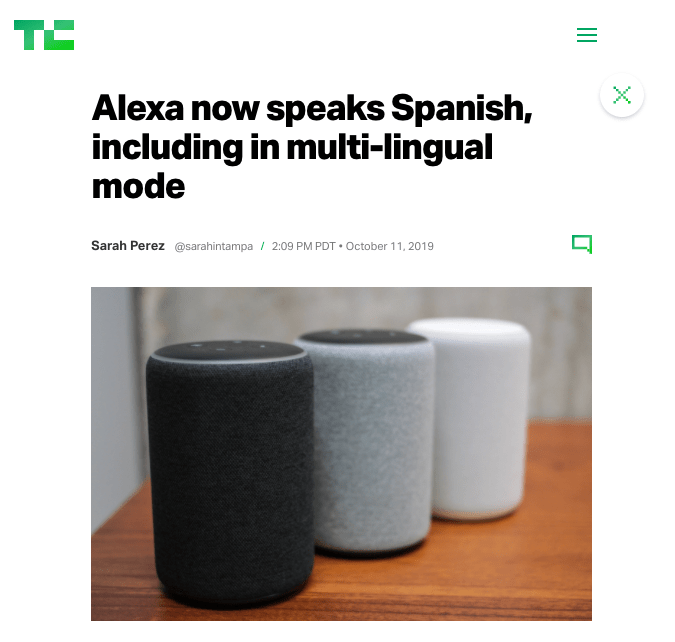
2017-2021
Team(s): Alexa International, Alexa AI – Translation
Role: Lead UX Designer
Activities: Voice + multimodal interaction design, design guideline publication, user research and testing, product management, NLU work, marketing/PR
Product(s): Multilingual Mode, Live Translation, Voice Settings for Languages, Alexa – U.S. Spanish, regional-device out-of-box UX
Vision + Design Guidelines
I owned multilingual Alexa CX related to global expansion and multilingual functionality, incl. language settings, regional devices, multilingual functionality, international Alexa voices, and translation. Some of the most personally meaningful work I’ve done was work on U.S. Spanish for Multilingual Mode.
This lateral vantage point led me to create a coherent vision, tenets and and mental model around customer language signals (and language access as accessibility) that was applied to myriad North Star and Working Backwards documents, team mission statements, product design decisions, and beyond.
I also co-led creation of Designing for Global Customers guidelines in Alexa Design Guide (HIG) for internal and external Alexa builders.
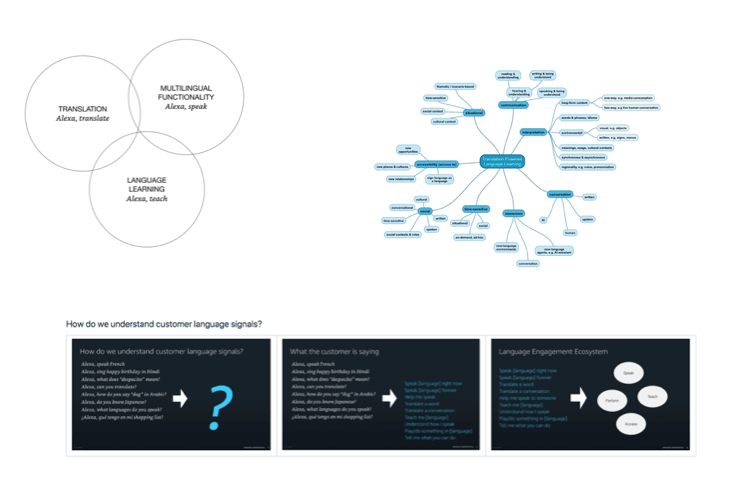
Multilingual Alexa Tenets
Tenets and examples of how they were applied to product design:
1) Alexa should understand customers, period, and respond in a single most-relevant language. Multilingual Alexa should respond as would a multilingual human.
-
We assume a bias for adding languages, e.g. when a customer speaks or asks Alexa to speak another language. Language as a “setting” is a technical construction, not a human one; we work backwards from a natural human speech model. Languages will only be removed/swapped by explicit request or consent.
-
If a customer speaks to Alexa in a language, we understand that is the strongest possible implicit signal and honor that intention.
-
Alexa should respond in a single most-relevant language.
2) Alexa is multilingual, the customer doesn’t need to be. Assume customer can only understand their own language, e.g. to make language selection or understand instruction.
-
This applies end-to-end, from packaging to language selection during setup.
-
We should not direct the customer to another language to complete a task, e.g. due to feature disparity. Potential risks of double failure and/or offensiveness outweigh potential benefit.
-
Two-way doors in CX should be possible in all languages, e.g. not dependent on one language. Do not create one-way doors via language disparity.
3) We are proud of Alexa’s multilingual abilities. Multilingual functionality should be easy to discover, with discoverability adjusted for each country’s unique sociolinguistic profile.
Voice Settings for Languages
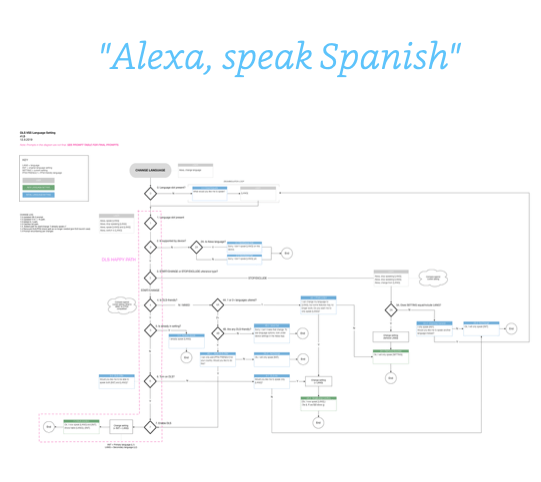
I initiated, designed, and PMed the launch of VSS (Voice Settings) for Language Settings, incl. leading language modeling (NLU) work. This was one of the first voice-enabled settings on Alexa, and launched shortly after and adjacent to Multilingual Mode in 2019.
Experience: Customers using Alexa in any language around the world can change their Echo device from any language to any language, including multilingual operation for some locales and language combinations.
Problem solved: Prior to this, customers could only find this setting buried in the Alexa App or Settings on multimodal devices.
Result:
1. Multilingual Alexa discovery and engagement instantly and dramatically increased.
2. Friction eliminated for customers already trying to do this.
3. Ongoing marketing, discovery and PR could now use “Alexa, speak [language]” as a powerful and direct way to promote feature.
Multilingual Mode + U.S. Spanish
In addition to the CX tenets and their technical/business applications described above, I led the UX work around making the multilingual functionality that this introduced — with all its experiential novelty + disparities — make sense to customers, working with Alexa Personality as well locale/country UX and business teams on developing best practices for discovery, ongoing engagement, and everyday use. I worked with Alexa TTS (Text-to-Speech) team, Alexa country managers, and a high-judgement Hispanophone panel to examine and select the U.S. Spanish voice for Alexa.
I spoke in my Amazon Pioneer profile why I felt this was important work:
“… within the past year she worked on the launches of Multilingual Mode and US Spanish, which makes Alexa more useful for bilingual households — like the one Jill grew up in. As a second-generation Latina, she is proud to be a part of bringing greater language accessibility to customers. The new functionality allows Alexa to respond in the same language that is spoken to her, and is now available in the US, Canada, and India. ’We are able to meet customers where they are – how they speak and how they live,’ says Jill.
… ’I consider myself a global citizen — and customer — and I bring that into work every day,’ she said.”
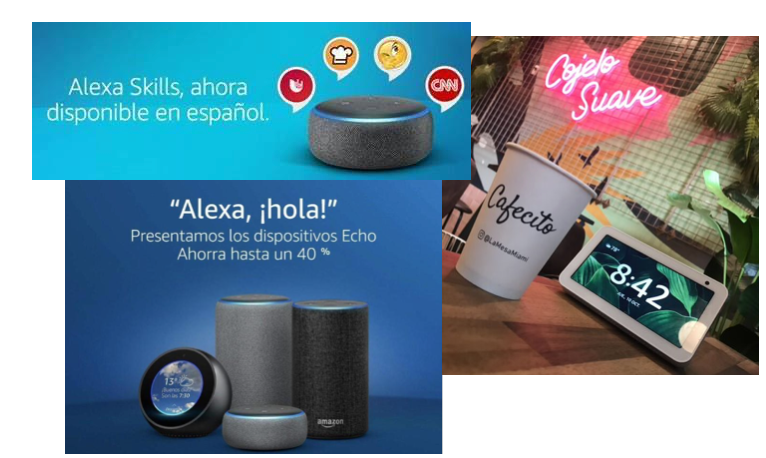
I also independently initiated, ran, and socialized user research and testing with Spanish-speaking U.S. Latinos that helped to answer for the business:
-
What does it mean for a single Alexa [device] to speak in multiple voices that may sound different from eachother?
-
What are the respective differences of bilingualism in U.S. vs. Canada vs. India? What are primary vs. secondary languages in these locales, e.g. are English and Spanish both primary languages in the U.S.?
-
What is U.S. Spanish anyway — vocally, culturally — and how is it distinct from our Spain and Mexico regional voices and personalities?
 JILL.DESIGN